













İngilizce Meb Yayınları Yes You Can B1.1 Ders Kitabı Sayfa 97 Cevabı
Bu sayfa 2017-2018 eğitim-öğretim yılı içeriğidir.
Kitabın güncel basımı kontrol ediliyor…


İngilizce Meb Yayınları Yes You Can B1.1 Ders Kitabı Sayfa 97 Cevabı
2017 - 2018 Eğitim Öğretim dönemiyle beraber pek çok ders ve çalışma kitabı değişti. Değişen ders kitaplarından biri de "İngilizce Meb Yayınları Yes You Can B1.1 Ders Kitabı Cevapları" oldu. Kitabı incelediğimizde ise Devrim ÖZBEK, Hatice KUMRAL, Sevinç ÖRER tarafından 132 sayfa olarak kaleme alındığını görüyoruz. Kitapta görseller ön plana çıkarılmış ve görsel tasarım ise Beyza DİRİK, Zafer HAŞİMOĞLU tarafından yapılmış.
"İngilizce Meb Yayınları Yes You Can B1.1 Student's Book Sayfa 97 Cevapları"nda önce sorular yazıldı daha sonra cevaplar verildi.
SORULAR
Welcome from Switzerland.3. For habits:I get up early every day.Carol brushes her teeth twice a day.We visit our grandparents every weekend.4. For things that are always / generally true:It rains a lot in winter.They speak English at work.We use the base form of the infinitive. (İn the third person we add ‘S’ in the end to the verb.)SubjectVerbThe Rest of the sentenceI / You / We / TheylearnEnglish at school.He / She / ItlearnsEnglish at school.The spelling for the verb in the third person differs depending on the ending of that verb:1. For verbs that end in -O, -CH, -SH, -SS, -X, or -Z we add -ES in the third person. go - goescatch - catches wash - washes kiss - kisses fix - fixes2. For verbs that end in a consonant + Y, we remove the Y and add -IES. marry - marriesstudy - studies carry - carries worry - worriesNOTE: For verbs that end in a vowel + Y, we just add -S. play - plays enjoy - enjoys say - saysNegative Sentences in Simple Present TenseTo make a negative sentence in English, we normally use Don’t or Doesn’t with ali verbs.When the subject is he, she or it, we add doesn’t between the subject and the verb to make a negative sentence. Notice that the letter S at the end of the verb in the affirmative sentence (because it is in third person) disappears in the negative sentence.Negative Don’t = Do not Doesn’t = Does notWord Order of Negative SentencesSubjectVerbThe Rest of the sentenceI / You / We / Theydon’t learnFrench at school.He / She / Itdoesn’t learnsFrench at school.Negative Sentences with Don’t and Doesn’t:You don’t speak Spanish.John doesn’t speak Italian.We don’t have time for a rest.İt doesn’t move.They don’t want to go to the party.She doesn’t like fish.Interrogative Sentences with Don’t and Doesn’t:To make questions in English, we normally use Do or Does at the beginning of the sentences.
İngilizce Meb Yayınları Yes You Can B1.1 Ders Kitabı Sayfa 97 Cevabı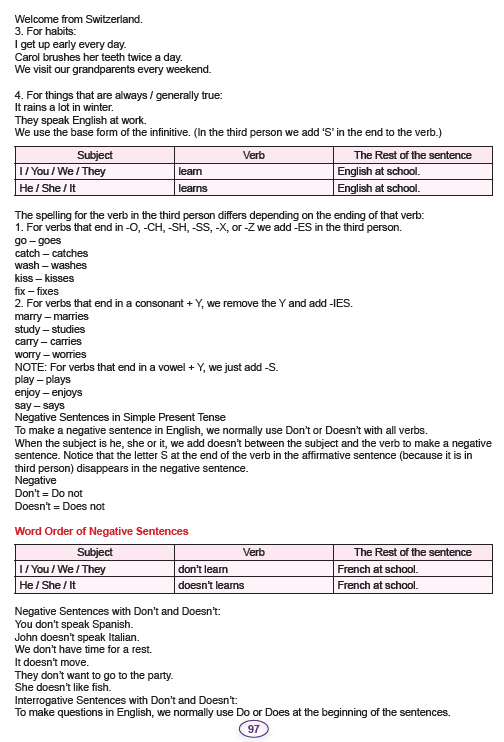


Henüz yorum yok
Sorularını paylaş, diğer öğrencilerin yorumlarını oku. Yorumlar onaydan sonra yayınlanır.
Henüz yorum yok