












İngilizce Meb Yayınları Yes You Can B1.1 Ders Kitabı Sayfa 108 Cevabı
Bu sayfa 2017-2018 eğitim-öğretim yılı içeriğidir.
Kitabın güncel basımı kontrol ediliyor…


İngilizce Meb Yayınları Yes You Can B1.1 Ders Kitabı Sayfa 108 Cevabı
2017 - 2018 Eğitim Öğretim dönemiyle beraber pek çok ders ve çalışma kitabı değişti. Değişen ders kitaplarından biri de "İngilizce Meb Yayınları Yes You Can B1.1 Ders Kitabı Cevapları" oldu. Kitabı incelediğimizde ise Devrim ÖZBEK, Hatice KUMRAL, Sevinç ÖRER tarafından 132 sayfa olarak kaleme alındığını görüyoruz. Kitapta görseller ön plana çıkarılmış ve görsel tasarım ise Beyza DİRİK, Zafer HAŞİMOĞLU tarafından yapılmış.
"İngilizce Meb Yayınları Yes You Can B1.1 Student's Book Sayfa 108 Cevapları"nda önce sorular yazıldı daha sonra cevaplar verildi.
SORULAR
AdjectivedullfullshrillAdverb of Mannerdullyfullyshrillyiv. Adjectives ending in ueWhen the adjective ends in ue, the final e is usually omitted before the ending ly is added. For example:Adjective Adverb of Mannerdue dulytrue trulyv. Adjectives ending in yWhen the adjective ends in y preceded by a consonant, the y is usually changed to i before the ending ly is added. For example:AdjectivebusyeasyhappyAdverb of MannerbusilyeasilyhappilyHowever, in the case of the adjectives shy and sly, ly is simply added to the positive form of the adjective:Adjective Adverb of Mannershy shylysly slylyWhen the adjective ends in y preceded by a vowel, in most cases, ly is simply added to the positive form of the adjective. For example:Adjective Adverb of Mannercoy coylygrey greylyHowever, in the case of the adjective gay, y is changed to i before the ending ly is added:Adjective Adverb of Mannergay gailySee Exercise 1.It should be noted that while most adverbs which end in ly are adverbs of manner, other types of adverb may also end in ly. For instance, consequently and subsequently are connecting adverbs. The following are adverbs of frequency which are formed by adding ly to the corresponding adjectives.AdjectivefrequentrareusualAdverb of Mannerfrequentlyrarelyusually
İngilizce Meb Yayınları Yes You Can B1.1 Ders Kitabı Sayfa 108 Cevabı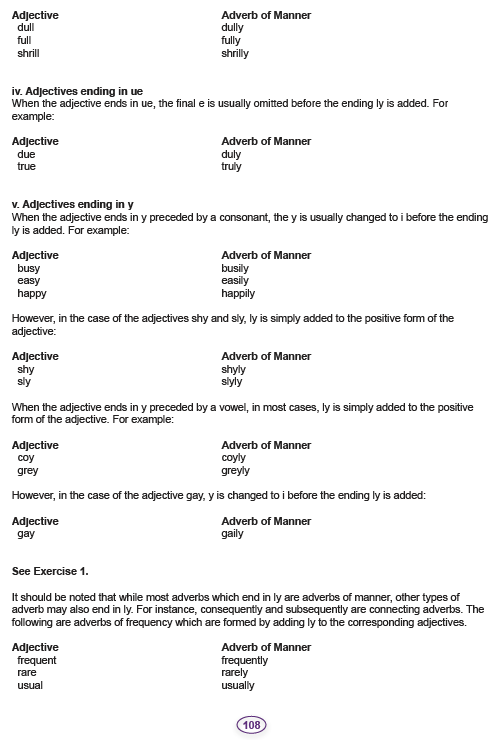


Henüz yorum yok
Sorularını paylaş, diğer öğrencilerin yorumlarını oku. Yorumlar onaydan sonra yayınlanır.
Henüz yorum yok